
What Is Terrazzo Mosaic?
- Jeevan Kasturi
- May 31
- 5 min read

Terrazzo is one of the oldest and most enduring surface materials in human history a composite flooring and wall finish made by embedding chips of marble, granite, quartz, glass, or shells into a cement or epoxy binder, then grinding and polishing the surface to a luminous, seamless sheen.
The result is a material that is simultaneously ancient and utterly modern: rich with color, infinitely customizable, and built to last centuries. From the grand floors of Venetian palaces to the lobbies of mid-century American skyscrapers, terrazzo has been a signature of architectural ambition and artisanal quality.
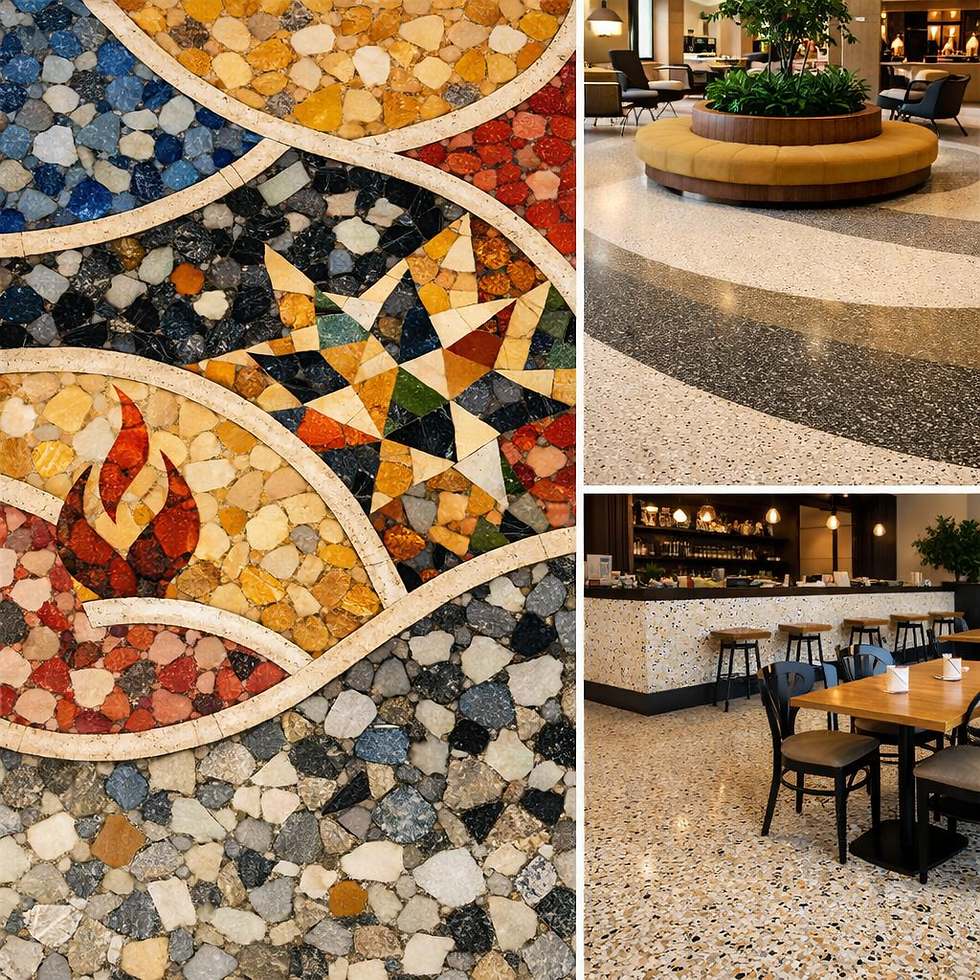
Terrazzo is not simply a floor it is a canvas. Every chip is a brushstroke, every slab a painting you walk upon.
A Journey Through Time
The story of terrazzo spans more than fifteen centuries, winding from the workshops of ancient Egypt through Renaissance Italy to the gleaming countertops of today's design studios.
1500 BC — Ancient Origins
Early forms of terrazzo appear in Egypt and the Middle East, where workers embedded stone fragments in clay and lime binders to create durable surfaces for temples and palaces.
1400s — Venice, Italy
Venetian mosaic workers (terrazzieri) began using leftover marble chips mixed with goat milk as a binder to create residential floors. This gave the material its name from the Italian "terrazza" (terrace). Workers slept on these floors to warm the setting material with body heat.
1800s — Portland Cement Era
The invention of Portland cement in 1824 transformed terrazzo. A stable, affordable binder meant terrazzo could be used in public buildings, train stations, and government edifices across Europe and North America.
1920s–1960s — Golden Age
Art Deco and Modernist architects embraced terrazzo as the defining floor material of the era. Miami's South Beach, Rockefeller Center in New York, and airports worldwide were graced with bold geometric terrazzo compositions.
1970s–1990s — Decline & Competition
The rise of affordable carpet and vinyl tiles pushed terrazzo into decline. Its labor-intensive installation process made it less competitive in the mass market.
2000s–Present — Renaissance
Epoxy-based terrazzo, prefabricated tiles, and a renewed appetite for artisanal materials fueled a global revival. Today terrazzo appears in fashion boutiques, tech campuses, and luxury homes as a symbol of refined taste and sustainability.
The Many Faces of Terrazzo
Modern terrazzo comes in several distinct systems, each suited to different applications, budgets, and aesthetic goals.
Cement-based (Traditional)
Mixed and poured on-site. Offers seamless, custom patterns. Requires skilled labor and 72 hour curing. Ideal for large public spaces.
Epoxy-based (Modern)
Uses polymer resin binder. More flexible, brighter colors, thinner slabs (6mm vs 25mm), and faster installation than cement system
Precast Terrazzo Tiles
Factory-made slabs with consistent thickness and quality. Easy to install like standard tiles. Perfect for residential renovations.
Venetian (Seeded)
The original Italian style using large (50mm+) marble chips for a bold, high-contrast look. Often features brass divider strips separating color zones.
Glass-chip Terrazzo
Incorporates recycled glass pieces for sparkling, reflective surfaces. Popular in sustainable design projects. Adds luminosity under light.
Rustic / Exposed Aggregate
Left ungrouped with a raw, natural finish. Prominent texture makes it ideal for outdoor terraces and stair treads where grip matters.
How Terrazzo Mosaic Is Made
Creating terrazzo is a meticulous, multi-stage process that blends engineering precision with artistic vision. Here is how a traditional poured-in-place terrazzo floor is born:
Surface Preparation
The concrete subfloor is cleaned, leveled, and inspected for cracks. Any imperfections are repaired. A bonding agent or isolation membrane is applied to ensure adhesion and prevent moisture migration.
Divider Strip Installation
Brass, zinc, or aluminum strips are set into the wet underbed according to the design blueprint. These dividers define color sections, control cracking, and are a distinctive visual element of classic terrazzo.
Mixing the Matrix
Marble or glass chips (aggregate) are combined with Portland cement or epoxy resin and pigments in precise ratios. Each color section is mixed separately to maintain color purity and consistency.
Pouring & Spreading
The terrazzo mix is poured into each section defined by the divider strips and spread evenly at a thickness of 10–25mm (cement) or 6mm (epoxy). Additional chips are sometimes seeded on top for denser coverage.
Initial Grinding
After curing (24–72 hours for cement), the surface is ground with progressively finer diamond abrasive pads starting at 40 grit and moving to 400 grit. This exposes the chips and creates a flat, even plane.
Grouting & Fine Grinding
A cement slurry or matching grout is applied to fill pinholes left by grinding. After drying, further grinding with 800–1500 grit pads creates an increasingly smooth and reflective surface.
Polishing & Sealing
The floor is polished to the desired sheen from a satin matte to a mirror-like gloss. A penetrating sealer is applied to protect against stains and moisture. The final surface is ready to walk on.
Where Terrazzo Shines
Terrazzo's versatility makes it suitable for almost any surface in both residential and commercial contexts. Its inherent waterproof quality, hygienic surface, and long lifespan make it especially practical in high-traffic environments.
Floors & Staircases
The most classic application. Terrazzo floors can span thousands of square meters seamlessly, incorporating logos, geometric borders, or narrative motifs. Staircase treads in terrazzo develop a beautiful patina over decades of use.
Countertops & Kitchen Surfaces
Epoxy terrazzo countertops have surged in popularity, offering a heat-resistant, non-porous surface that resists bacteria. Custom chip compositions mean no two kitchens look alike.
Bathroom Walls & Wet Rooms
Precast terrazzo panels or poured epoxy systems are ideal for shower walls and bathroom floors. The seamless surface eliminates grout lines where mold and mildew typically thrive.
Furniture & Decorative Objects
The terrazzo aesthetic has expanded far beyond architecture into tabletops, planters, lamp bases, phone cases, and fashion accessories carrying its cheerful, speckled pattern into everyday life.
Caring for Your Terrazzo
Properly maintained terrazzo can last hundreds of years there are Roman terrazzo floors that remain intact today. Here are the essential care principles:
Sweep or dust-mop daily to remove grit that can scratch the surface Re-seal cement terrazzo every 3–5 years with a penetrating sealer
Avoid acidic cleaners (vinegar, lemon juice) they etch the marble aggregate Don't use abrasive scrub pads that can scratch polished surfaces Mop with pH-neutral cleaner diluted in water for routine cleaning Buff with a soft floor machine to restore shine between professional polishes Never use bleach or ammonia-based products on cement terrazzo Avoid dragging heavy furniture directly across the floor without felt pads
An Eco-Conscious Choice
In an era of fast materials and disposable design, terrazzo stands out as a remarkably sustainable option. Its aggregate often consists of up to 70–80% recycled content marble offcuts from quarries and fabrication workshops, post-consumer glass, and industrial by-products that would otherwise enter landfill.
Because a well-laid terrazzo floor can last a century or more without replacement, its embodied carbon is amortized over an extraordinarily long service life, making its per-decade environmental footprint far lower than carpet, hardwood, or vinyl alternatives that require replacement every 10–20 years.
The greenest building material is one that never needs replacing. In that light, terrazzo may be the most sustainable floor on earth.
Why Terrazzo Endures
Terrazzo mosaic has survived fifteen centuries of architectural fashion because it occupies a rare intersection: it is simultaneously functional and beautiful, ancient and contemporary, industrial and artisanal. It rewards patience — both in its creation and in its appreciation.
Whether you are designing a new home, restoring a heritage building, or simply curious about the speckled floors beneath your feet in an airport or hospital, terrazzo is a story worth knowing a testament to the human impulse to make even the most utilitarian surfaces worthy of wonder.
To know more , reach us on hr@smartplot.in or https://www.surfaceelements.in/. Smart Plot Surface has best solution in designs and for External construction materials. https://maps.app.goo.gl/fn77MDRqp3GTAQy88


Comments